
Most sim rig posts are basically parts lists. They show the cockpit, list the hardware, maybe throw in a few impressions, and that is kind of it. That stuff is fine, but it skips the part I actually care about now. Once I am in the rig trying to put together clean laps for more than ten minutes, the gear itself matters a lot less than whether the whole setup helps me stay consistent.
That is what I care about most at this point. Not immersion. Not having the fanciest hardware. Not upgrading things just because they look cool in product photos. I want to get in the rig and have everything feel exactly the same as it did the last time I drove. No shifting around. No fiddling with positions. No weird little differences that make the first few laps feel off. Just sit down and drive.
That is how this setup ended up where it is. Not from some grand plan. More like slowly removing anything that made the rig less repeatable or more distracting.
The chassis changed more than I expected
I did not think the chassis mattered that much at first.
I was using a Playseat Trophy for a while and it was totally fine. Comfortable, easy to move, nothing obviously wrong with it. If you are just getting into this stuff, it is easy to think the chassis is mostly just the thing that holds everything else.
Then I switched to a SimLab P1X Pro, and the difference was immediate in a way that is kind of annoying because now it is hard to un-feel it.
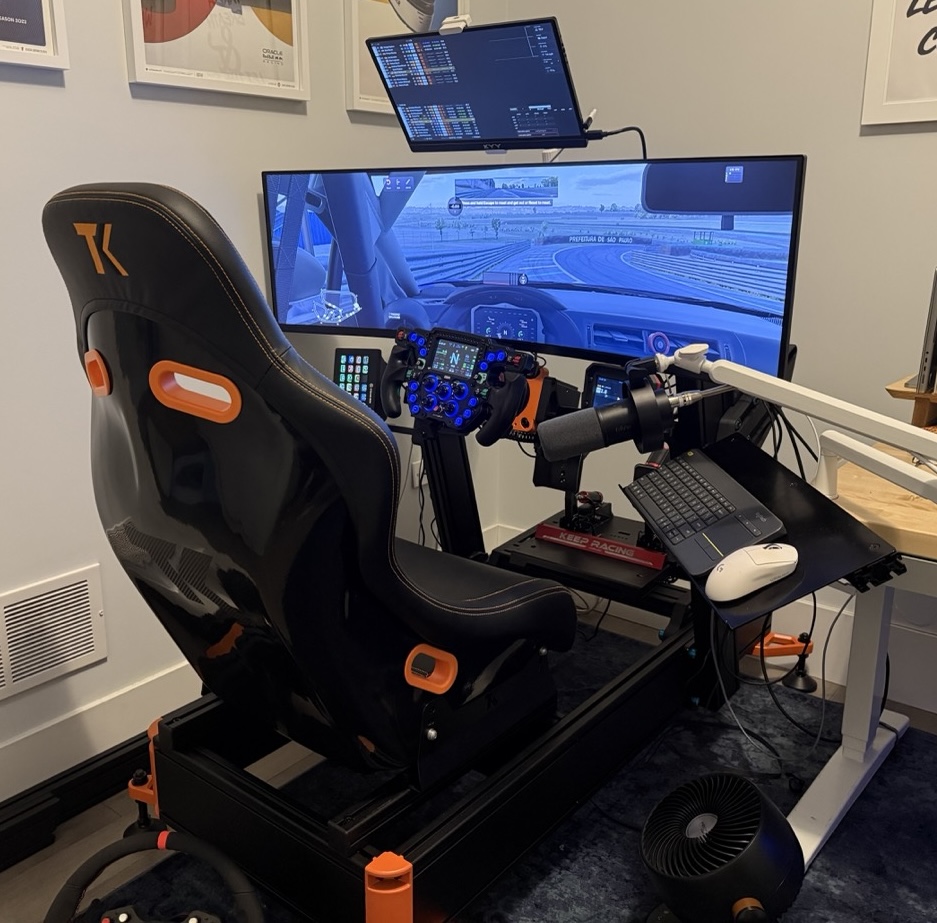
Nothing moved anymore. Under braking, the pedals stayed planted. The wheelbase stayed put. The whole thing felt locked in instead of just good enough.
That was the real difference. Not that it suddenly felt more exciting. It just stopped introducing little inconsistencies I had gotten used to without really noticing. Once the chassis stopped flexing and shifting, the rest of the rig got easier to trust.
It also helps that the P1X is still easy to adjust. If I need to tweak the steering angle or move something a little, I can. I do not want a rig that is annoying to dial in. I just want one that stays dialed once it is there.
The pedals probably made me faster
If I had to pick the thing that actually made me faster, it would probably be the pedals.
I started on Logitech pedals, which is how a lot of people start. They work, but braking with them always felt a little vague. You can be reasonably consistent on them, but there is still a lot of guessing mixed in. It is hard to build clean muscle memory when the thing you are trying to repeat does not feel that precise.
Now I am on Simagic P1000s with the pedal haptics, and that changed everything.
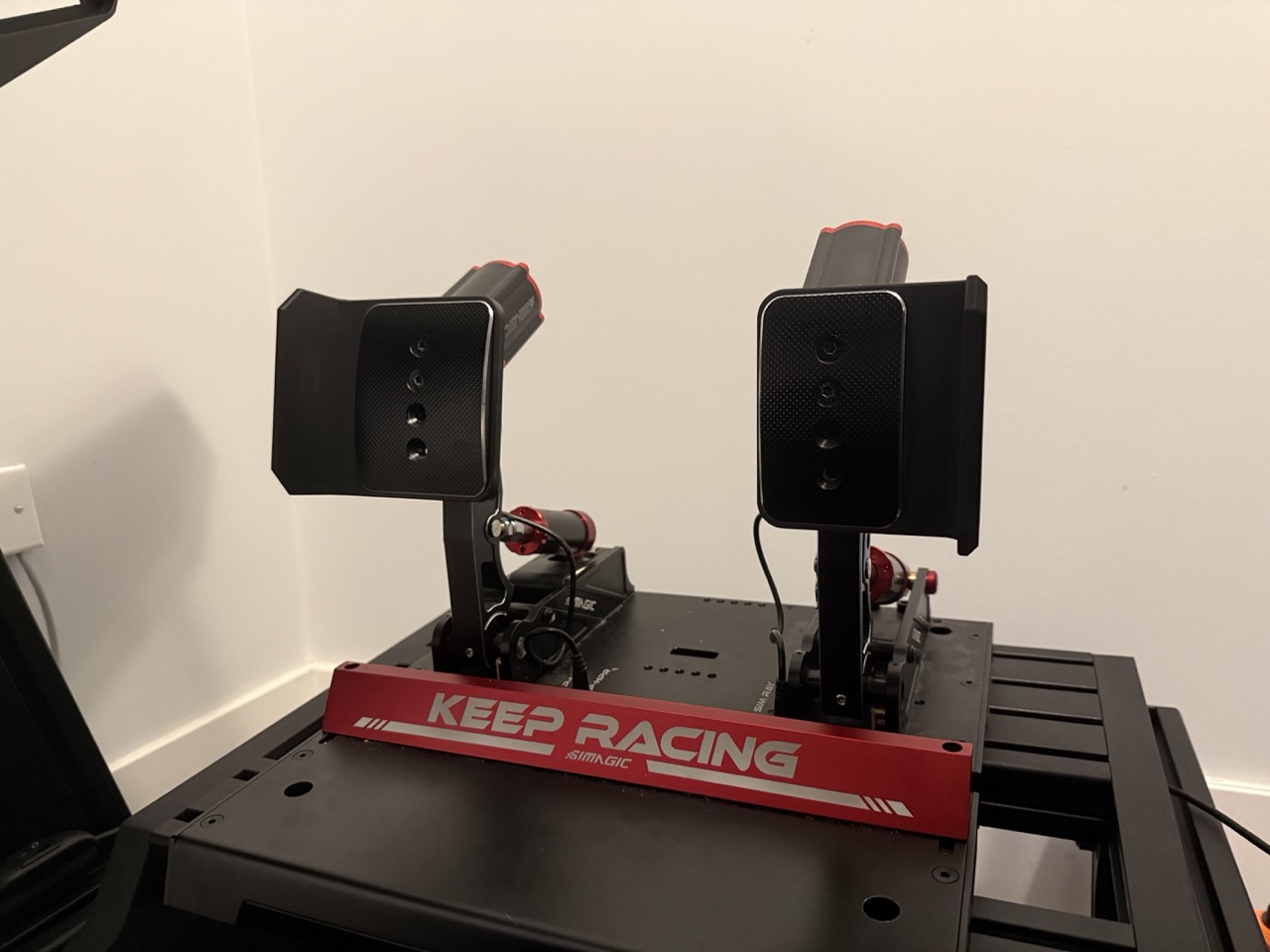
The load cell is the biggest part of that. Once braking becomes about force instead of just pedal travel, it gets way easier to repeat. I do not have to think about it as much. I can just hit the same pressure again and again.
The haptics ended up being way more useful than I expected too. I have them set so I can feel ABS through the pedals, and I also use them for curbs. Both are genuinely useful. Feeling ABS makes it easier to sit right on the edge instead of creeping over it without realizing. Feeling the curbs helps too, especially when I am trying to figure out whether I am actually using enough of the track or just telling myself I am.
It sounds a little gimmicky until you spend time with it. Then it just starts feeling like useful information.
The wheelbase is good, even if it is probably next on the upgrade list
I am using a Simagic Alpha Mini for the wheelbase, and it has been really solid.
It gives me enough detail to catch little slips and react earlier, which is mostly what I want out of it. I do not need some absurd amount of force just for the sake of it. I mostly want the car to communicate clearly enough that I am not late to everything.
That said, this is probably the next thing I would upgrade. Not because the Alpha Mini is bad, but because a little more headroom would be nice, and some of the newer options have cleaner quality-of-life stuff like USB pass-through so I do not have to run a cable off the wheel itself.
For wheels, I have two setups. My main one is a GSI Hyper P1, which feels great in hand and is probably the nicest part of the rig in terms of materials and build quality. I also have a simple round MPI wheel on a basic button-box-style setup for oval and rally racing.
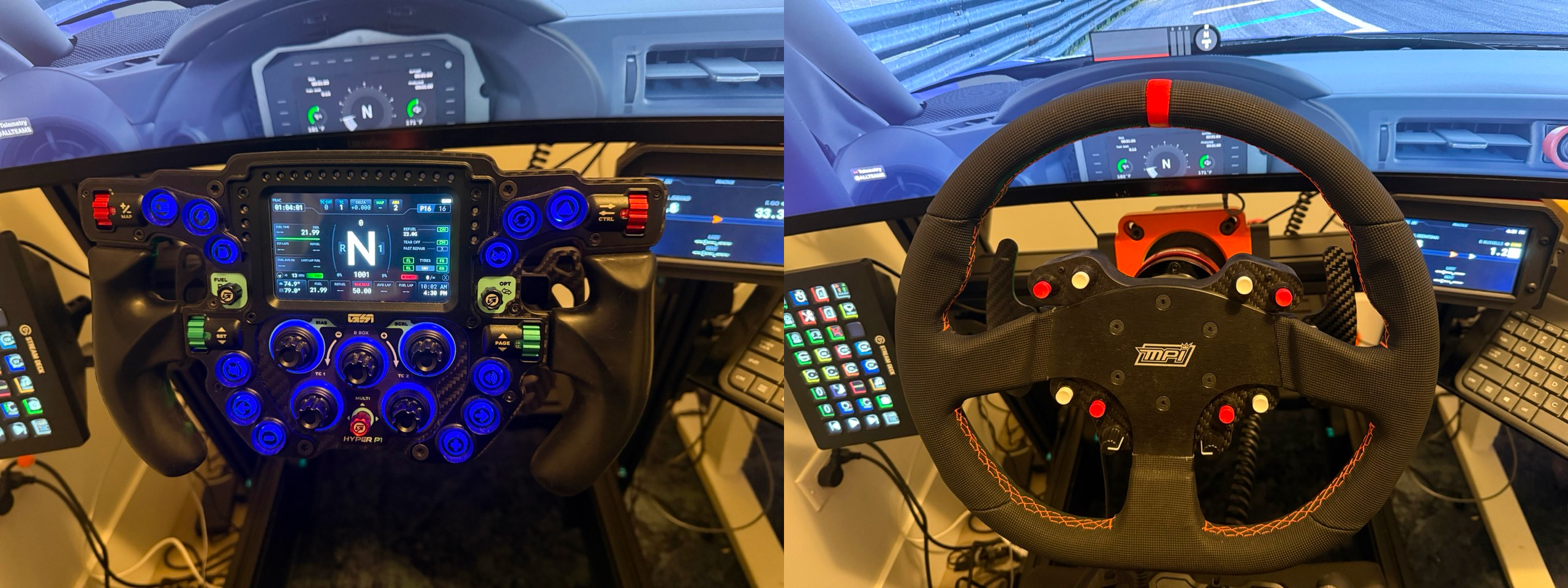
The one thing I would not buy again is a wheel with a screen on it. It is just not that useful for me. In my current GT-style seating position, it is not really in my natural line of sight, and even when I do look at it, it is small enough that I am not getting much out of it. If I was in a more formula-style driving position, maybe it would be visible but in this position it's not. If I was buying again, I would get a wheel without a screen and not think twice about it.
That is a pattern across a lot of this setup, honestly. Plenty of things look useful in theory. Fewer of them actually change how I drive.
Getting the screens right mattered more than picking hardware
The trickiest part of this whole setup was not really the hardware. It was figuring out where information should live so I could use it without constantly distracting myself.
I used to keep a lot more on the main screen. All of the RaceLab overlays were there, always visible, easy to reference. At first that felt nice because everything was right in front of me. Then I realized I was looking at all of it all the time, even when I shouldn't be. It was useful information, but it was also noise.
So I split things up.
I have an LG 45-inch ultrawide as the main display, a 15-inch USB monitor mounted above it, and then a small 5-inch USB display mounted lower down underneath.
Once I did that, the whole thing made more sense. Each screen got a job.
Main screen
The main screen is mostly just for driving.
I keep a few things on it, but only things that matter right now. The biggest one is brake input telemetry. That is probably the single most useful overlay I have because it lets me see exactly what I am doing with the brake in real time. If I am not trailing off properly or I am braking harder than I think I am, I can see it immediately.
That has been really useful for building better habits because I can watch track guides, see what good braking looks like, and compare it to what I am actually doing instead of just guessing.
I also keep a small delta on screen so I can tell if a lap is tracking red or green without having to think too hard about it. Then in the lower left I have a track map. That one is less about pace and more about recovery. If I spin or get out of shape, I can quickly see where everyone is and figure out if I can safely pull back on track.
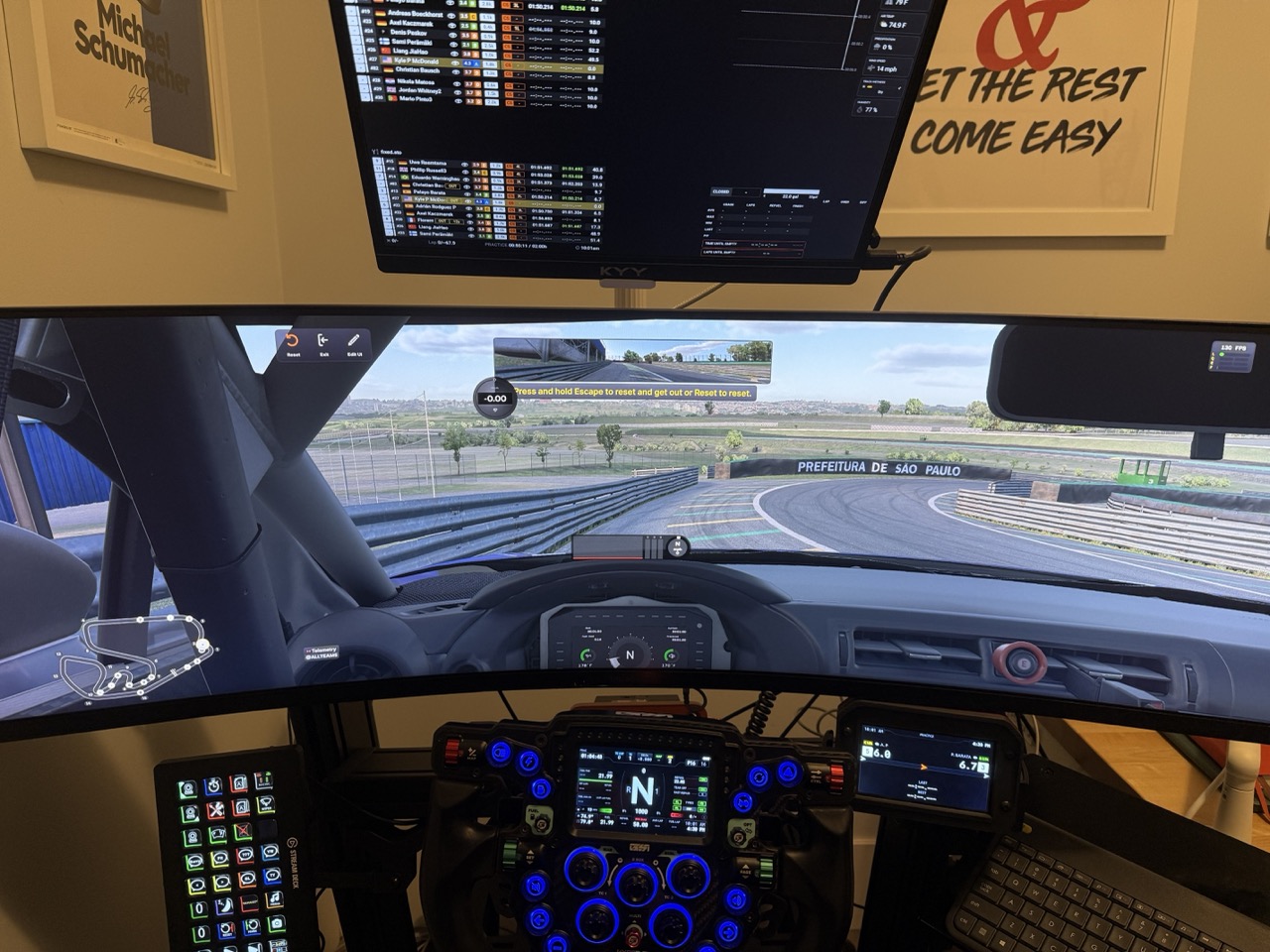
That is basically it. I do not want the main screen packed with stuff anymore because if it is there, I will look at it. I know that about myself now.
Top screen
The top screen is where I put all of the data.
This is all RaceLabs. Relative, standings, lap graph, track temp, and fuel all live up there.
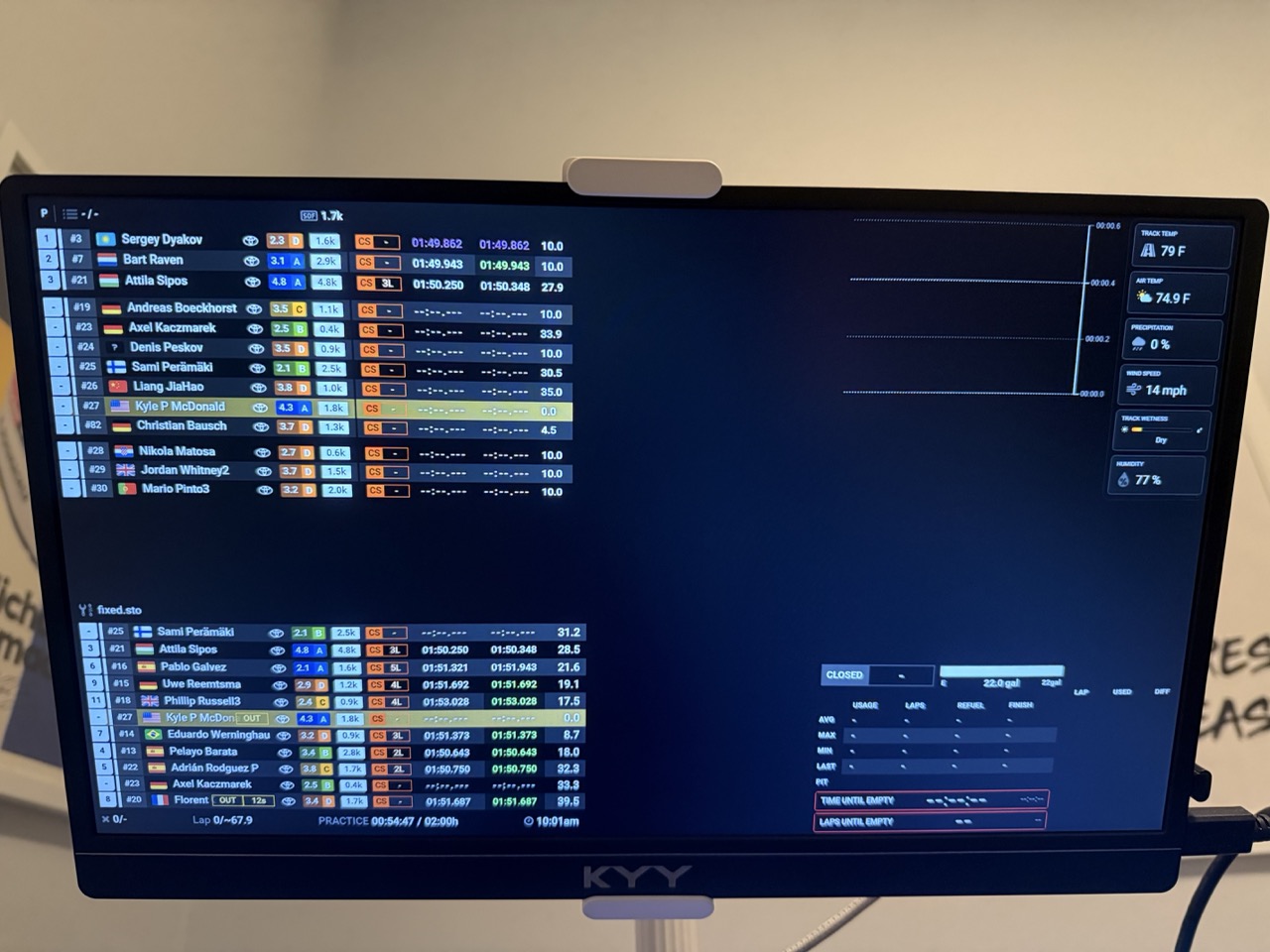
This is the screen I glance at on straights or whenever there is a moment to breathe a little. It gives me the bigger picture. Where I am. What the gaps look like. Whether the fuel number still looks healthy. Whether track temps are changing. Whether my lap times are actually improving or if I just feel like they are.
I like having all of that available. I just do not want it sitting directly in the middle of the driving view.
Lower screen
The little lower display is probably the part of the setup that makes the least sense in a photo and the most sense once I am actually driving.
During races, I use it to show the exact gap to the car ahead and behind. That makes it easy to glance down and immediately know if someone is actually getting close or if it just feels that way. During qualifying, it switches over to a sector-by-sector readout so I can see how the lap is building without giving more space on the main display to it.
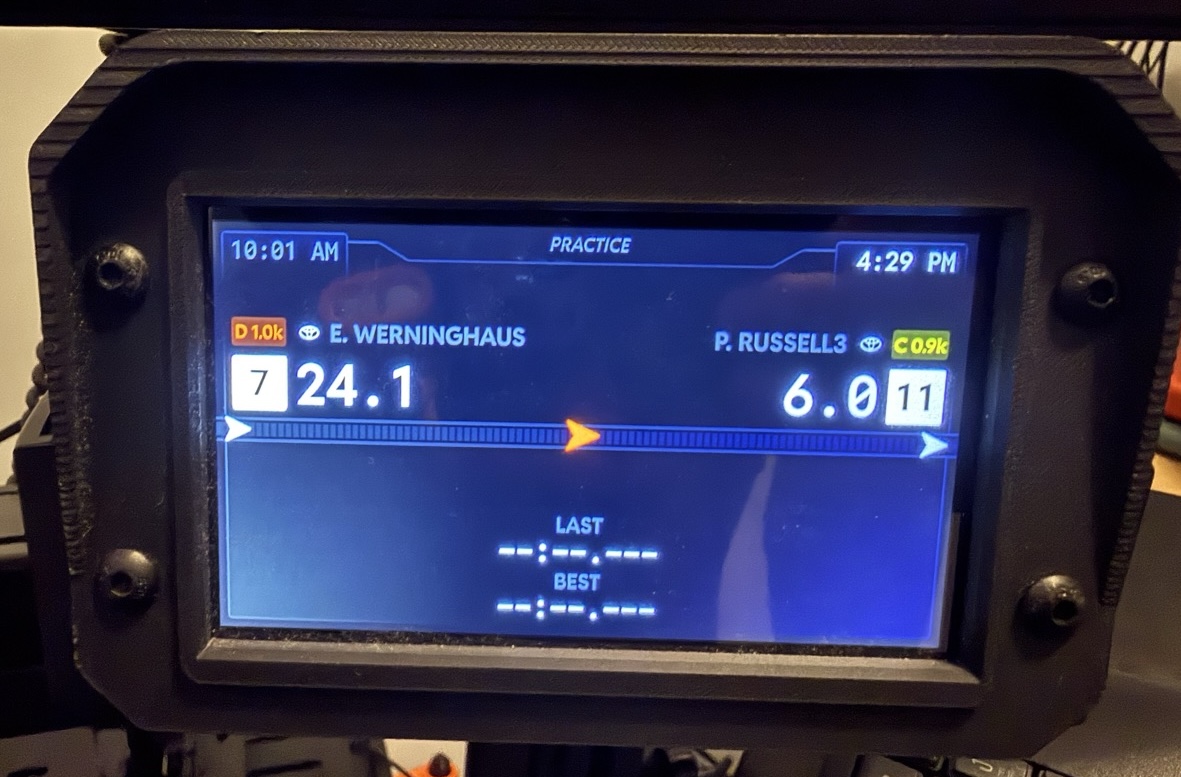
The reason it works so well is mostly just where it sits. It is closer to where my eyes already are, so it is faster to reference than looking up. Small thing, but it changes how often I can use the information without feeling like I am pulling myself out of the lap.
That screen and the wheel screen are both running dashboards through SimHub, and I use Daniel Newman Racing for those dashboards along with the LED setup on the Hyper P1. The nice part there is that the lights match the in-car behavior so that I don't have 2 different RPM readouts when driving. Even if I do not care much about the wheel’s built-in screen, I do care that the rest of the visual cues feel familiar.
What I look at changes depending on the session
One reason I wanted to write this at all is that most setup posts do not really talk about usage. They show the screens, maybe list the software, but do not really explain how that changes between practice, qualifying, and the race.
Practice is where I am looking at brake telemetry the most. That is when I am trying to understand whether I am actually braking the way I think I am, whether I am improving, and whether the references I picked up from a guide or another driver are showing up in my own inputs. The lap graph matters more there too because I care more about trend than a single lap.
Qualifying is a little different. That is where the lower screen showing sector information matters more because I care more about how the lap is building corner by corner. The delta still matters, obviously, but qualifying feels more focused on execution than context.
During the race, the top screen and lower screen matter more together. Relative and standings give me the bigger picture, while the little screen gives me the exact gap information I can glance at without really breaking concentration. Fuel is always in the background too. Not in some obsessive way, just enough that I always kind of know if things are still on track.
That was the shift for me. I do not need all the information all the time. I just need the right information in the right place for the part of the session I am in.
The Stream Deck ended up replacing the button box
I bought a button box at one point because it felt like something a proper sim rig should have.
And it was fine. It worked. It looked cool. But once I had a Stream Deck XL in the rig, the button box kind of stopped making sense.
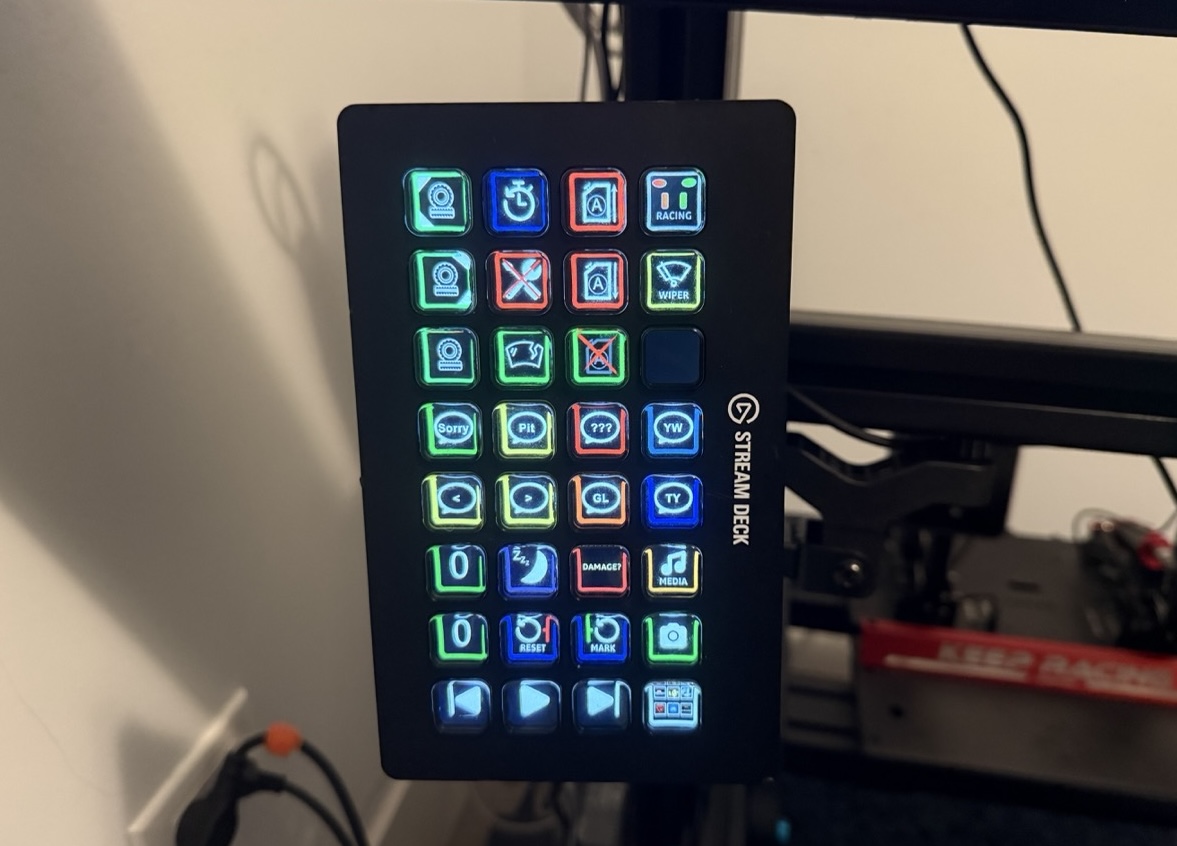
The Stream Deck is just way more flexible. I use it for pit stops, in-car adjustments, replays, and launching all the stuff I need before I even get on track. The big advantage is that I can change it whenever I want. If I find a better layout, I can change it. If a specific car needs something different, I can change it. If I realize some workflow is annoying in the middle of a race week, I can fix it without buying new hardware or living with it forever.
That is just way more useful than a static box of buttons.
This is another place where the rig drifted toward how I work in general. I like tools that can be shaped around actual usage instead of forcing me into whatever the original layout was supposed to be.
Gloves and shoes were less cosmetic than I expected
This is another thing I probably would have dismissed earlier as mostly cosmetic.
I use custom gloves from IMB with my number on them, and they are by far my favorite gloves I have tried. The grip is really good, they fit well, and they make the connection to the wheel feel more consistent than the other gloves I have used.
I also switched to Sparco racing shoes more recently. For a long time I was just driving in socks, which does work, but it is not as consistent as I thought it was. Once I started using actual shoes, the pedal feel got a little more predictable, my feet were less bothered over longer stints, and the whole thing just felt more stable.
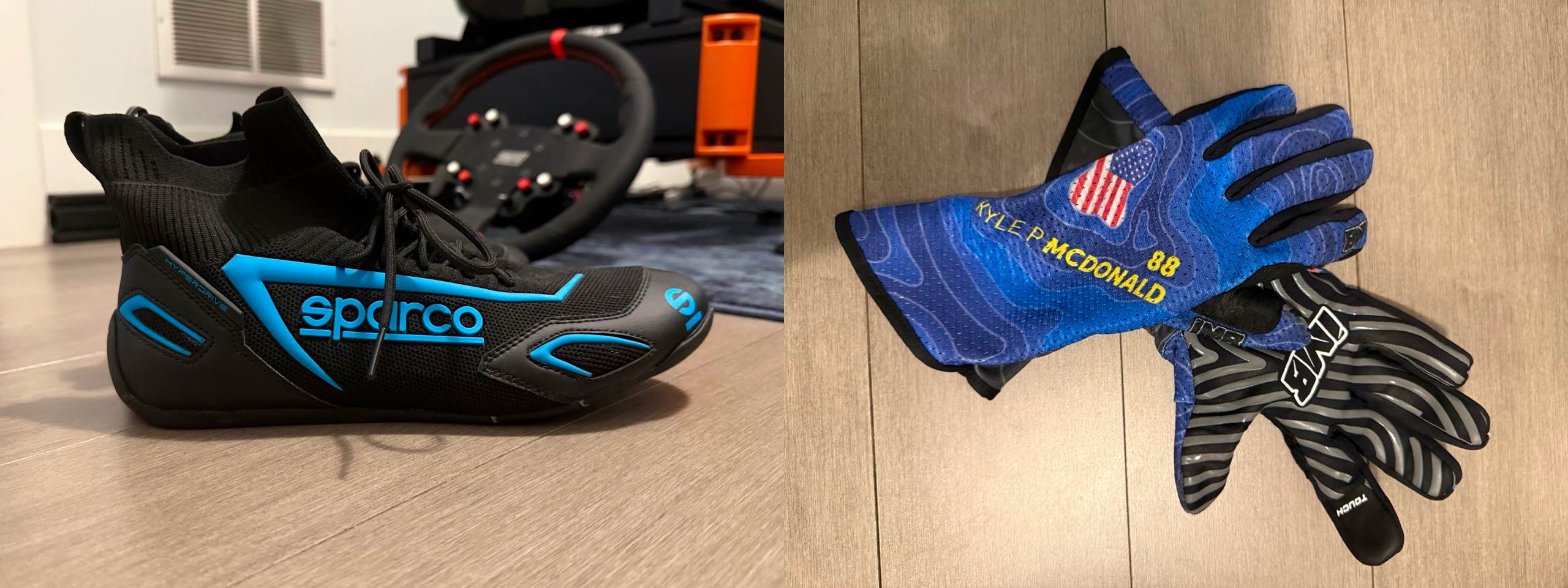
This is one of the few places where the more immersive option also ended up being the more practical option.
The rest is pretty straightforward
The PC is a 4070 Ti Intel build. Nothing too wild there. It just needs to run everything comfortably, and it does.
For audio, I use in-ear monitors, which I really like for longer sessions. They are more comfortable for me than over-ears, and I can run the cable behind my head so it is not annoying. Small thing, but again, that is kind of what this whole setup became. A bunch of little choices that make the rig easier to use for longer without something stupid bothering me.
I do not have a shifter or handbrake yet. At some point I could see adding a sequential shifter if I get more into rally or oval stuff, but for what I do now, mostly GT3 leagues and endurance racing, I do not really need it.
What actually mattered
The parts that made the biggest difference were not the ones that looked the coolest in photos. It was the rigid chassis, the load cell pedals, the pedal haptics, the clearer wheelbase detail, and the way I split information across multiple screens so I was only looking at what mattered when it mattered.
The Stream Deck belongs on that list too. So do the gloves and shoes, honestly, even though I probably would have rolled my eyes at saying that a while ago.
What all of those things have in common is that they made the setup more repeatable. They reduced distraction. They made it easier to build habits and trust what the rig was telling me.
That is really the whole point. The interesting part of a sim rig is not the parts list. It is whether the setup disappears enough that you can just drive.